

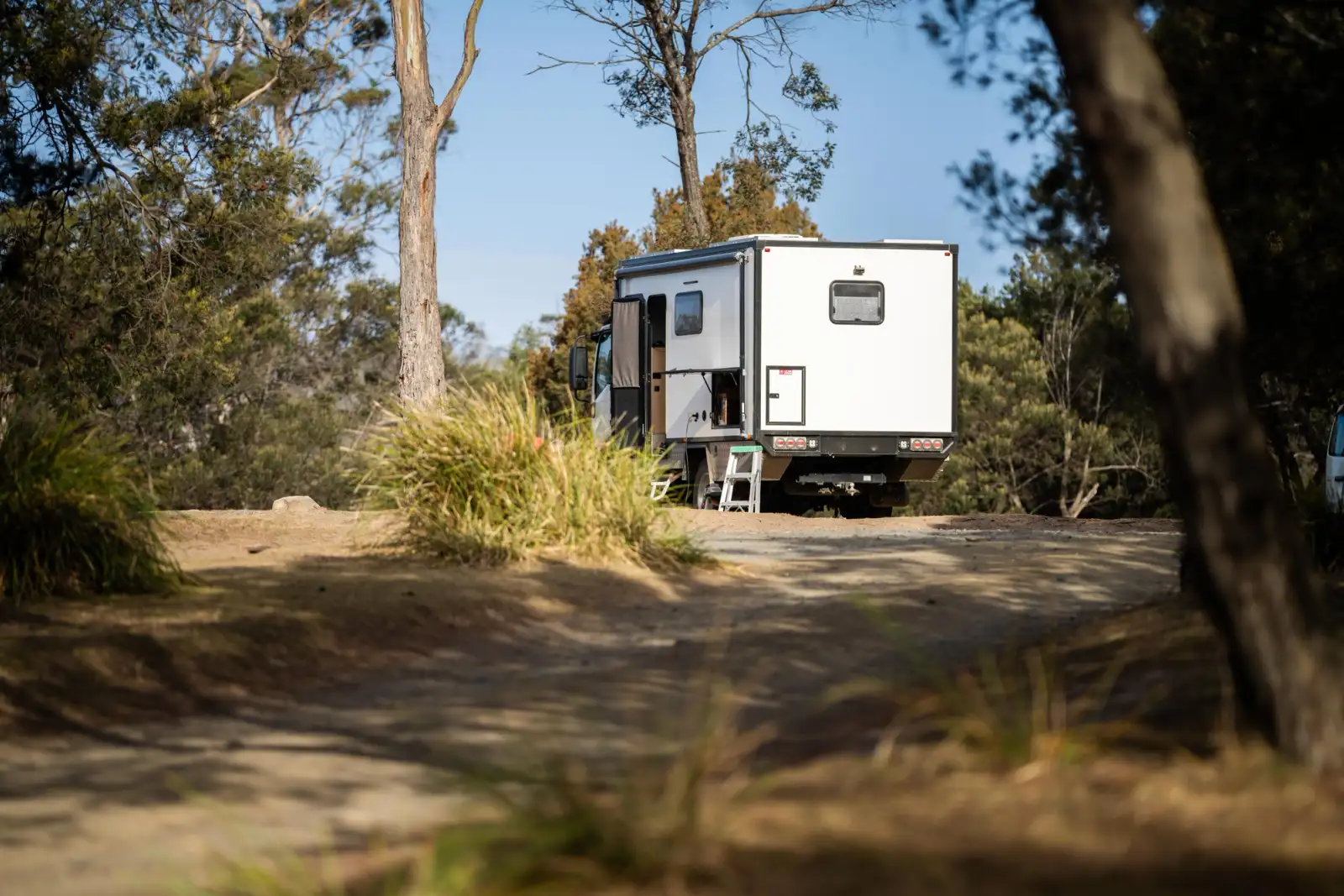
Hitting the road in a motorhome or campervan is one of the best ways to explore Australia. But to truly enjoy off-grid camping, remote travel, and long-haul touring, the right RV accessories make all the difference.
From solar power systems to safety gear and smart storage solutions, upgrading your setup can turn a basic vehicle into a comfortable, self-sufficient home on wheels.
This guide covers the must-have RV accessories for Australian conditions, helping you build a setup that’s ready for everything from coastal camps to remote outback tracks.
Power and Electrical Accessories for Off-Grid RV Travel
For travellers who spend time off-grid or in remote areas, having the right power setup is key. Often the foundation for any comfortable RV setup, getting this right will ensure you can manage any other modifications you install, help you stay connected and keep you on the road for longer.
Solar Panels
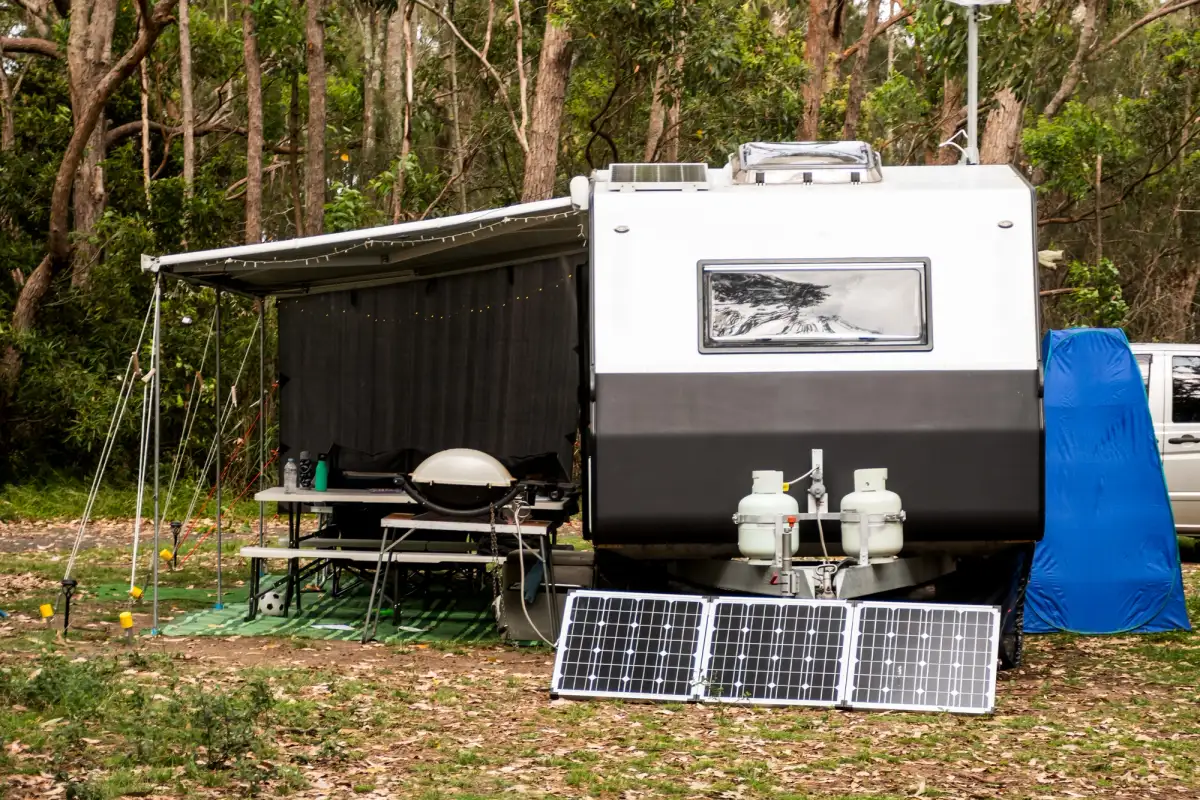
Caravan with solar panels
Solar energy is an ideal source for RV owners as it is clean and can be used repeatedly. Using this power, you can charge batteries, power lights, tools and even air conditioning.
There are two main ways solar panels are used by motorhome and campervan owners in Australia. The first are portable panels. These are the easiest to set up and use, giving you options and freedom.
If you park your motorhome in the shade, you can still move your panels into the sun, making them a convenient option for RV owners who want a flexible and more affordable option.
The other type is permanent solar panels, which are often mounted to the roof of RVs. In the long term, they may save you more money, but the initial installation cost will be more.
These panels will always collect solar energy, even when driving, so even if you park in the shade, they should have collected enough to keep the power on. As they are always on, it means less setup, but you should consider their weight and how this will affect fuel efficiency and your RV’s roof structure.
Battery capacity also matters. To make the most of your solar panels, you need a way to store the energy. Having a reliable battery storage system means you can power more appliances for longer.
As a rough guide, two 100-watt panels should power your lights, charge devices, and run small appliances like a portable fan or coffee maker. If you’re looking to run air conditioning or larger electrical devices, you’ll need a more extensive setup, possibly up to 400-watts, with an inverter, more panels and higher-capacity batteries.
Lithium Battery Upgrade
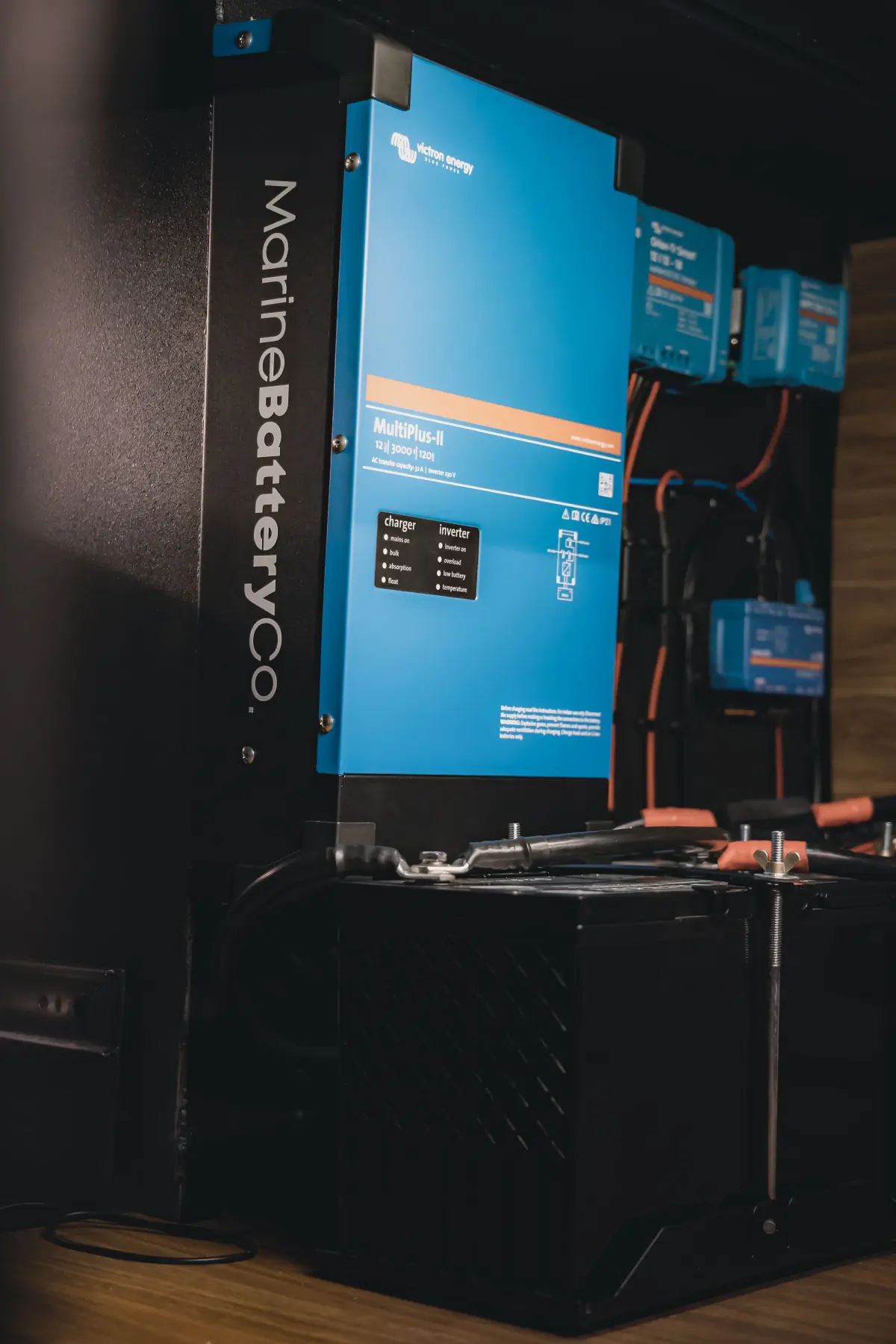
12V battery system
Lithium batteries are the high-performance power banks you need for life on the open road.
There are a number of reasons RV owners are making the switch from traditional lead-acid batteries. Benefits include:
- A long lifespan: A quality lithium battery typically lasts 8-10 years in your RV, handling over 2000 full charge cycles. This makes the upfront cost a smart investment.
- Safer installation:Minimal gassing means safer installation inside living areas (always follow the manufacturer's instructions, though).
- Smaller payload: Lithium batteries weigh roughly half to one-third of a comparable lead-acid unit. Less weight means better fuel economy and easier handling, especially important on corrugated Aussie tracks.
- Charging speed: Lithium batteries accept charge from solar panels or generators much quicker than lead-acid batteries, which means less time waiting and more time adventuring.
- Steady power delivery: Lithium batteries maintain voltage until they’re nearly flat. Lead-acid batteries drop their voltage steadily, leading to dimmer lights and underperforming appliances.
- Set and forget: No topping up water levels. No corrosive acid leaks. Lithium batteries are sealed and a truly hassle-free experience.
To choose the right lithium battery for your setup, consider:
- Daily power needs (fridge, lights, gadgets, etc.)
- Voltage (12V is standard)
- Battery management system (BMS)
- Cycle life (Look for batteries rated for 2000+ cycles at 80% DoD or better)
- Warranty
- Charging compatibility (your RV’s existing charger must match lithium profiles)
- Fit and terminals
DC-DC Charger
A DC-DC charger may just be one of the first things you consider when setting up your RV’s electrical setup. Used to manage power flow between your RV’s alternator and auxiliary battery (like a lithium battery), they boost and regulate voltage to ensure it charges efficiently, regardless of your alternator’s output.
Selecting the right one will come down to your battery type, power needs and vehicle setup.
Inverter
Inverters convert direct current (DC) to alternating current (AC) power. By doing so, they convert the 12V of DC supplied by the battery into 240V of AC at the plugs, allowing you to charge your phone or laptop and help RV owners who travel with continuous positive airway pressure (CPAP) machines for sleep apnoea.
Like the other RV accessories, picking the right one will come down to your needs and your space.
Safety and Recovery Accessories
Travelling through Australia’s often extreme terrain and climate comes with challenges that can be partly helped or mitigated through some RV accessories. Especially on unsealed roads and in remote regions, where the demand for preparedness should not be underestimated. The right safety accessories can mean the difference between a minor inconvenience and a serious emergency.
Tyre Pressure Monitoring System (TPMS)
TPMS give RV drivers real-time updates on tyre pressure and temperature, reducing the risk of blowouts on long highway runs or corrugated dirt roads. Maintaining these levels is essential for RVs, where the full weight of your home, gear and passengers are being carried.
Underinflation is the leading cause of tyre failure in heavy vehicles, as it increases heat and stress on the casing. Overinflation is just as risky, amplifying impact damage on rough roads.
A TPMS will allow for instant feedback and therefore early warnings before a small issue becomes a failure.
Fire Extinguisher
Most RV owners rely on ABE dry powder extinguishers because they’re cheap, effective on common fires, and widely available. But they create corrosive dust, kill visibility, and don’t work well on lithium-ion battery fires, now common in RV setups. Lithium fires can self-sustain through thermal runaway, making them hard to stop. Newer options like aerosol or clean-agent extinguishers offer cleaner, more targeted suppression, helping contain flames without damaging electronics.
While no handheld unit can stop thermal runaway, early intervention can prevent spread. As RV tech evolves, so should safety gear. Choose extinguishers that match modern risks, not just tradition.
First Aid Kit
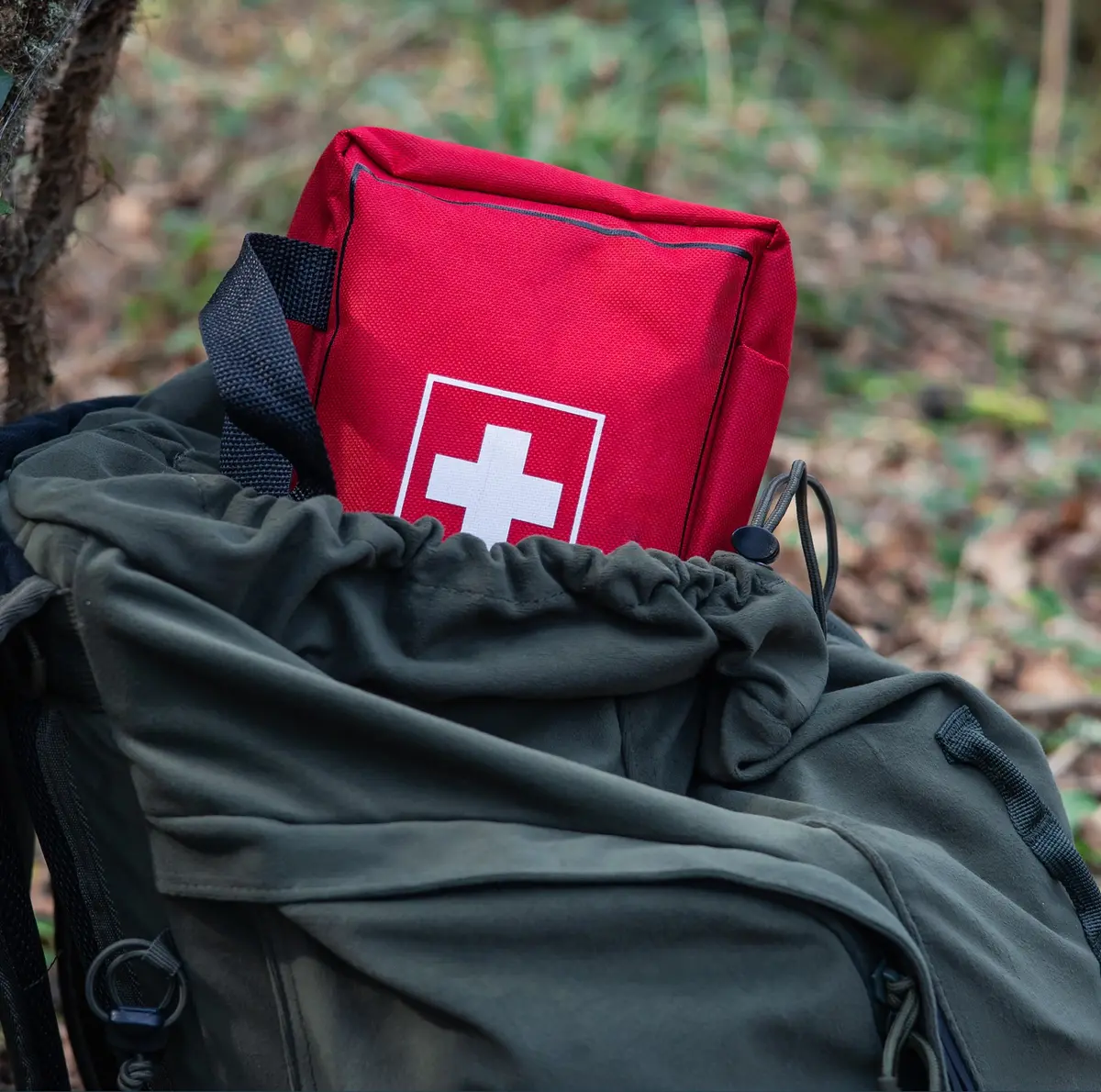
A first aid kit in a soft bag
Carrying a first aid kit while travelling Australia is non-negotiable. What you include in your kit is up to you, but we think there are some essentials and then some extras.
Must-Haves:
- First Aid Instructions/quick reference guide (x1)
- Notebook and Pen or Pencil (x1)
- Disposable surgical face masks (x4)
- Resuscitation face mask or face shield with one-way valve (x1)
- Disposable nitrile gloves – nitrile is a latex-free rubber suitable for people with latex allergies (x5 pairs in various sizes)
- Gauze swabs – sterile 3-pack of 10 x 10 cm (x5 packs)
- Saline (x8 of 15ml or x4 of 30 ml)
- Adhesive dressing strips – plastic or fabric (x1 packet of 50)
- Non-adherent wound dressing/pad – Small 5 x 5 cm (x6)
- Non-adherent wound dressing/pad – Medium 7.5 x 7.5 cm (x3)
- Non-adherent wound dressing/pad – Large 10 x 10 cm (x3)
- Conforming crepe bandage – Light 5 cm width (x3)
- Conforming crepe bandage – Light 7.5 cm width (x3)
- Conforming crepe bandage 10 cm width (x1)
- Scissors (x1)
- Adhesive Tape – non-stretch hypoallergenic 2.5 cm wide roll (x1)
- Dressing Combine Pad 9 x 20 cm (x2)
- Large Resealable Bag (x2)
- Triangular Bandage minimum width 110 x 155 cm (x2)
- Single-use eye pads (x2)
- Instant cold pack for treatment of soft tissue injuries and some stings (x1)
- Alcohol-based hand sanitiser (x1)
- Emergency accident blanket (x1)
Having these could help you and others in a range of situations.
Extras:
- Snake Bite Bandages
- Ointment for insect bites
- Antiseptic cream
- Soluble pain relievers
- Electrolyte replacement
- Antihistamine
- Insect repellent
- Salt, for leeches
- Personal medication, with instructions
- Tweezers and splinter needles
- Splint material
Carrying these supplies in a soft bag is recommended as it is easier to pack.
Emergency Communication Device
When travelling Australia’s remote regions, staying connected becomes a challenge. While mobile coverage is improving, you can’t rely solely on it.
For emergency-only communication, a personal locator beacon (PLB) is a compact, no-subscription device that sends a distress signal via satellite. Once activated, it sends your GPS location directly to Australian emergency services.
Another option is a satellite messenger. Instead of relying on terrestrial cell towers, they communicate directly with satellites orbiting Earth. Most satellite messengers require a subscription plan to access messaging, tracking, and SOS features. The cost varies based on the level of service, message limits, and coverage area.
They allow for:
- Two-way messaging: Unlike PLBs, they allow you to send and receive messages.
- SOS & emergency assistance: Built-in SOS button.
- Weather forecasting: Some devices provide weather updates based on satellite data.
- GPS tracking & location sharing: Users can share real-time location to loved ones or search and rescue teams.
- Navigation & mapping: Advanced models include topographic maps, waypoint marking and even route planning.
Wheel Chocks and Levelling Ramps
It’s easy to assume levelling ramps and wheel chocks are basically the same thing, but they’re not. One helps level your RV and the other stops it moving. Using the wrong one can lead to frustration, unstable setups, or worse.
Levelling Ramps
Levelling ramps are designed to elevate your RV and compensate for uneven ground. They’re typically made from heavy duty plastic, used under the wheels and driven onto slowly to reach the desired height. This is ideal for uneven or sloped sites that might interrupt sleep or the operation of fridges.
Without these you may notice swinging doors, fridge performance issues and problems sleeping. Levelling ramps solve these problems quickly.
Wheel Chocks
Wheel chocks are designed to stop your RV rolling once it’s in position. They sit against the tyres, rather than under them, preventing backward and forward movement. They should be used when parked on a slope and during levelling. Chocks are more about safety than comfort.
Comfort Accessories to Upgrade Your Campervan or Motorhome
Having the right comfort accessories make your RV feel like home. They make a significant difference on extended trips, particularly for families or grey nomads who are spending weeks or even months on the road.
Portable Fridge or Upright Fridge
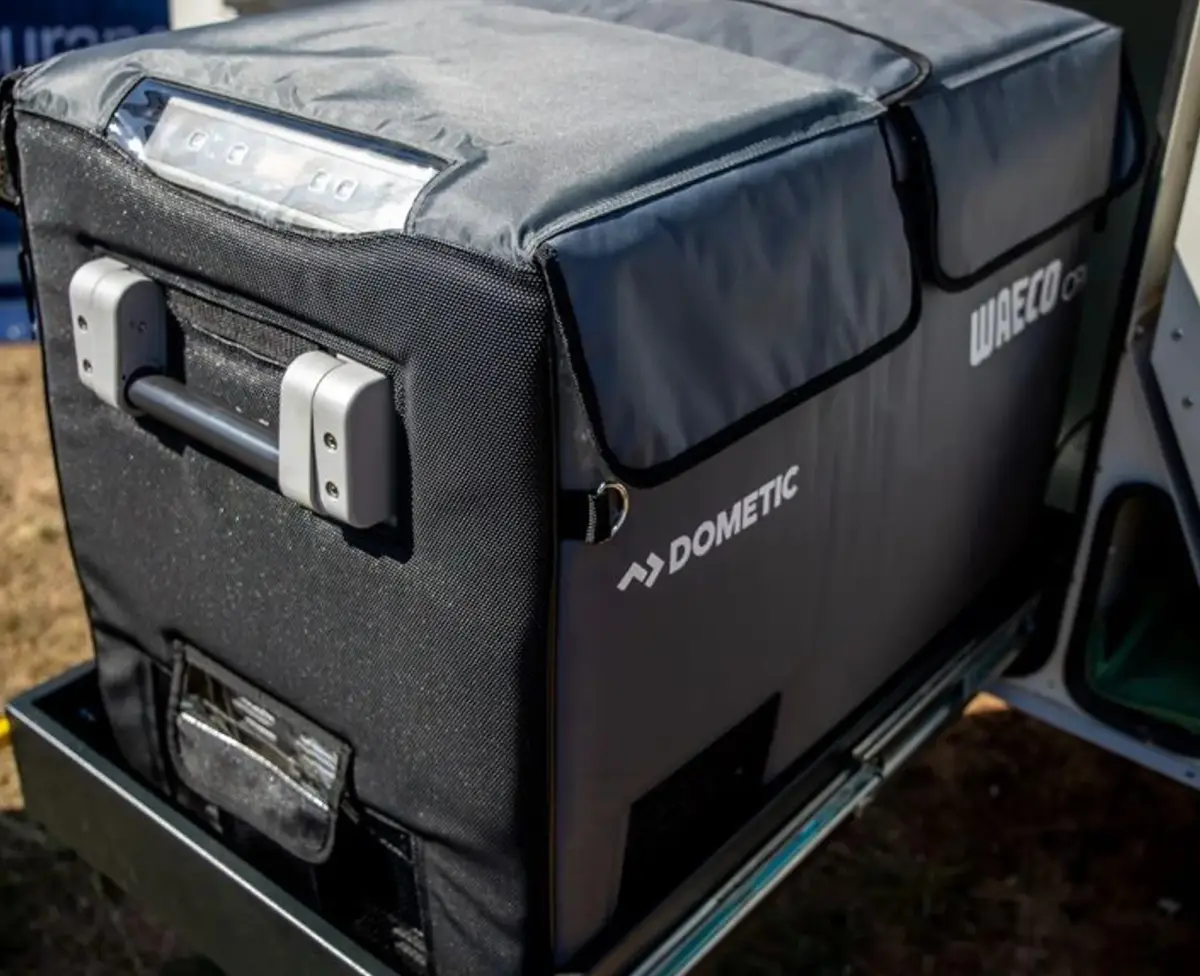
Portable camp fridge on a slide
Your RV’s fridge may just be the most important element to any good trip away. Nothing beats a cold beverage after a hot day or a perfectly cooked steak in the middle of nowhere. Depending on the size and setup of your motorhome or campervan, you are likely to have either a portable fridge or a permanent, upright fridge. There are some hybrid options, but these are the main two.
Larger motorhomes are likely to have an upright fridge in the kitchen, though some owners will still use a supplementary portable fridge for outdoor use or more storage. These fridges are just like at home. They save the hassle of digging through a chest fridge or venturing outside if the portable is there.
Portable fridges are common in campervan setups for their versatility and size. Capable of being tucked away on a slide means their contents are much more stable than their upright cousins.
Most commonly, upright fridges will have a capacity between 130L-190L and will depend on the number of people travelling as well as how long you’re away for.
Portable fridges usually range from 40L-50L, though smaller ones are great for weekend trips.
Awning
Under Australia’s harsh sun, you need shade, but no one wants to stay inside their RV or rely on a tree where they’re at the mercy of a bird’s bad stomach. This is where a good awning comes in to extend the living space and protect you from the elements.
There are two main types of awning: manual rollout awnings and electric awnings. The rollout awning has stood the test of time in the RV community thanks to its sturdy design. They’re built with high-quality materials and designed for regular use with no electrical components at risk of exposure to use or weather.
They do take a little extra effort to set up, but the reliability of the system is an attractive prospect for many RV owners.
Electric awnings are another great option, especially for grey nomads or solo travellers who may have more trouble setting up the manual awning on a regular basis. They offer the same protection, but with the convenience of a bush of a button.
Of course, they do rely on your setup’s electrical system, so as long as that is designed to handle it, then it can be an option many consider ideal for their travel style.
Portable Camp Furniture
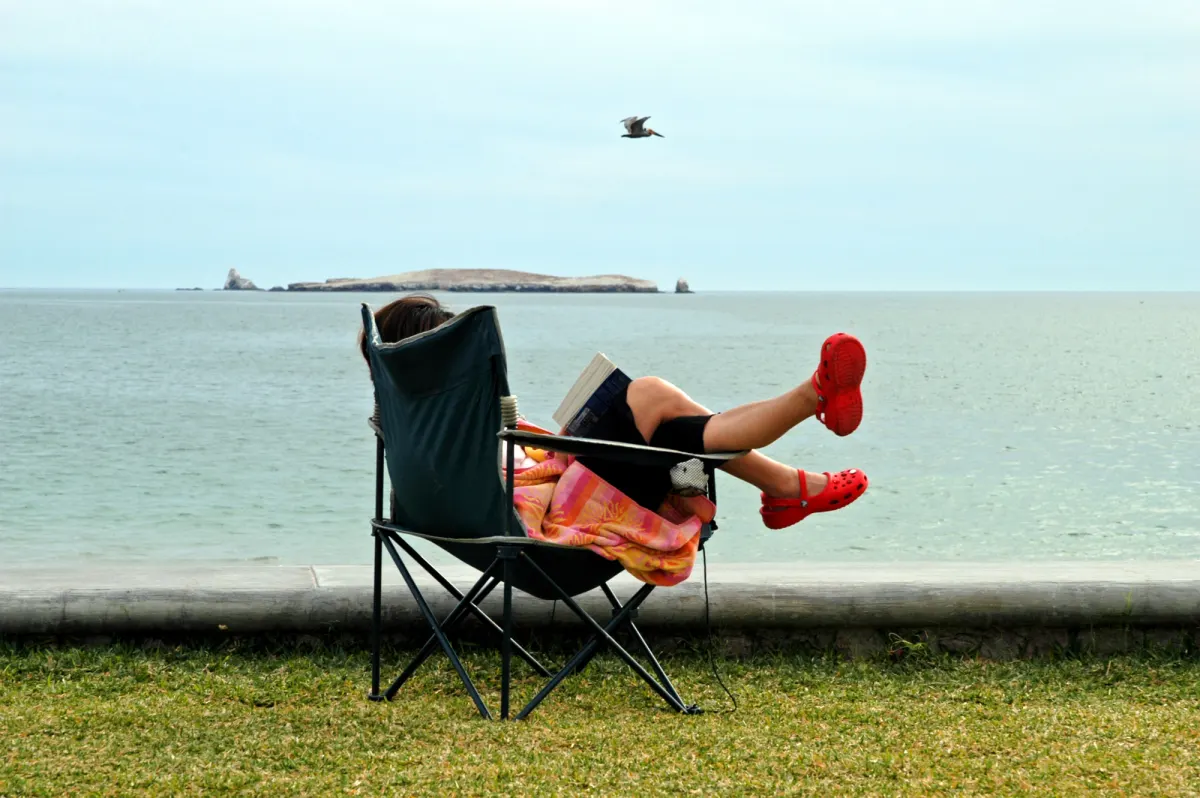
woman reading a book on a camp chair by the ocean
Sitting in your motorhome and campervan for every meal doesn’t seem like the best option, especially when the reason you’re travelling is probably for some space and the views that come with that. This is why a good set of camp chairs and a portable table are essential for any RV setup.
When you’re at camp, having a comfy place to sit is imperative. To eat, drink, play cards and watch the sunset. Nowadays, there are so many options for camp chairs. Of course, the classic with a cup holder will do the job, but you’ve recliners, moon chairs and ones with eskies in the arms to choose from to elevate your camp site experience.
A good table will also make a difference. One at a good height for your chair and sturdy enough to handle food prep and drink spills.
Mattress Topper or Bedding Upgrade
When you’re in your home away from home for an extended trip, getting a good night’s sleep is crucial. This is why exploring the option of a mattress topper or even a mattress upgrade is worth it.
Many RVs come with a standard mattress that is often replaced as soon as possible with something more suitable for the owner. This will most likely be something similar to what they sleep on at home. The addition of a mattress topper for extra comfort means you won’t be waking up on your holiday with a crook back and no energy.
Portable Shower or Hot Water System

Portable camp shower
A portable shower is excellent for RVs without an ensuite because it adds essential hygiene, comfort, and privacy without sacrificing valuable interior space or requiring expensive renovations
Installing a hot water system means it’s permanently fixed to your vehicle and it ultimately saves water and money. For RV owners with a 12V system, a gas hot water system is the best bet for staying clean while being off-grid. As long as you can manage your gas bottle’s levels and it is installed correctly, this option is perfect for travellers who want instant hot water.
Storage and Organisation Accessories
Space is always at a premium in any motorhome or campervan, and smart storage solutions can dramatically improve the liveability of any RV setup.
Roof Rack or Roof Pod
You’ve filled your RV with all the gear you need, but you’re out of space for your stand-up paddle board or a few extra jerry cans. That’s where a roof rack or pod might come in. They’re the perfect solution to the storage problem, providing a whole new area to store your goods.
It’s important to consider that a roof rack or pod in tandem with whatever you put on it will increase the height of your RV. This can impact where you can take your RV, however the only thing it should affect on the open road is your fuel efficiency.
If you’re the type of traveller who needs that little extra room for oversized camping or sports equipment, then considering a roof rack or pod may be for you.
Drawer and Organiser Systems
As discussed, storage is a vital commodity when camping. Adopting a minimalist approach is a good start, but for extended periods away, you will need to take some essentials, and a good drawer system can be a game changer.
The most common solution is a pull-out drawer system. Usually coming in single or double drawer designs, they are suitable for storing cooking utensils, food, clothing, and camping gear. Dividers can be handy to separate these items and keep them organised.
Drawers are more often found in the smaller campervans in the rear, though can be installed in all sorts of creative ways in any RV.
Cargo Barriers and Nets
Cargo barriers and nets are designed to keep your gear safe, secure and neatly organised. They also help protect passengers while preventing load shift. This can be helpful in a fully packed campervan or motorhome and allow for extra storage options on the inside of the roof with a net.
External Storage Boxes
Weatherproof external storage boxes are ideal for keeping camping and recovery gear organised in your vehicle. They can be packed up and kept in the back of your vehicle, often secured with cargo barriers or nets, and then unpacked at site for easy access.
A good quality, weatherproof option will ensure that even if left out overnight or on a roof rack, their contents will be protected.
Ready to Hit the Road
The right RV accessories can completely transform your motorhome or campervan, especially when travelling in Australia’s demanding conditions.
Whether you’re building an off-grid touring setup or upgrading for comfort on longer trips, investing in the right gear makes every journey safer, easier, and more enjoyable.
Start with the essentials, build around your travel style, and you’ll be ready to take on everything from coastal escapes to remote outback adventures.
RV Accessories Essentials Checklist:
- Solar panels (portable or fixed)
- Lithium battery system
- DC-DC charger
- Inverter
- Tyre pressure management system (TPMS)
- Fire extinguisher (modern type)
- First aid kit
- Emergency communication device (PLB or satellite messenger)
- Levelling ramps & wheel chocks
- Fridge (portable or upright)
- Awning
- Camp furniture
- Storage system (drawers, roof rack, or boxes)
Hitting the road?
Safeguard your lifestyle