

Why Your Motorhome Battery Matters More Than You Think
Your motorhome battery is the quiet workhorse behind every trip. It powers your fridge overnight at a free camp, keeps the lights on when you're parked under the stars, and runs your water pump first thing in the morning. Without a reliable motorhome battery setup, life on the road gets uncomfortable fast, especially in Australia, where off-grid travel is part of the appeal.
Whether you're doing the big lap, heading away for weekends, or mixing caravan parks with free camping, choosing the right battery makes a huge difference to how far, and how comfortably, you can travel.
This guide breaks down everything you need to know, from battery types and lithium vs AGM to charging systems, lifespan, and maintenance. It’s designed to help you make confident, practical decisions without getting lost in technical jargon.
Understanding the Two Types of Motorhome Batteries
One of the most common misconceptions for new owners is that there’s only one battery in a motorhome. In reality, there are two and each have a completely different job.
The starting battery (cranking battery) is responsible for starting the engine. It delivers a short, powerful burst of energy and is not designed to be deeply discharged.
The house battery (motorhome leisure battery) powers everything else: your fridge, lighting, water pump, USB outlets, and appliances. This is a deep-cycle battery designed to be discharged and recharged repeatedly over time.
When people talk about upgrading their motorhome battery, they’re almost always referring to the house battery. That’s where the real decisions and performance gains happen.
AGM vs Lithium: Which is the Better Motorhome Battery?
For most Australian motorhome owners, the choice comes down to two options: AGM and lithium (LiFePO4). Both have their place, it just depends on how you travel.
AGM Batteries
AGM (Absorbent Glass Mat) batteries are a type of sealed lead-acid battery where the electrolyte is absorbed into fibreglass mats. They’re maintenance-free, spill-proof, and handle vibration well—ideal for rough Australian roads.
Strengths:
- Lower upfront cost
- Widely available across Australia
- Reliable in varied conditions
- Compatible with most standard chargers
Limitations:
- Only ~50% usable capacity
- Heavier than lithium
- Slower charging speeds
- Shorter lifespan (typically 3–5 years)
Indicative price: $250 to $450 for a quality 100Ah AGM battery
Best for: Weekend travellers or those mostly staying at powered sites.
Lithium (LiFePO4) Batteries
Lithium Iron Phosphate batteries are now the go-to for serious travellers. They’re lighter, more efficient, and significantly longer-lasting. Other types of lithium batteries like Lithium Nickel Manganese Cobalt Oxide (NMC) and Lithium Cobalt Oxide (LCO) should be avoided.
Strengths:
- 80–100% usable capacity
- Much lighter (around half the weight of AGM)
- Faster charging
- Long lifespan (10+ years, 2,000+ cycles)
- Stable voltage output
Limitations:
- Higher upfront cost
- Requires lithium-compatible charging systems
- Needs DC-DC charger for alternator charging
- Reduced performance in extreme cold (rare issue in most of Australia)
Indicative price: $800 to $1,500+ for a quality 100Ah lithium battery
Best for: Off-grid travellers, grey nomads, and full-time motorhome users.
The Real Cost Over Time
While lithium costs more upfront, it often works out cheaper over time. You get more usable power, faster charging, and a lifespan that can be double that of an AGM.
For occasional travellers, AGM still makes sense. But if you spend serious time off-grid, lithium is usually the better long-term investment.
How Much Battery Capacity Do You Need?
Choosing the right motorhome battery size starts with understanding your daily power use. Read more on that in our guide to motorhome solar systems.
Typical Daily Power Usage
- 12V fridge: 30–60Ah per day
- LED lighting: 5–10Ah
- Water pump: ~5Ah
- Devices (phones/laptops): 5–15Ah
- Inverter appliances: varies significantly
Most setups use 50–100Ah per day.
Recommended Battery Capacity
Weekend travellers (powered sites):
- 100Ah AGM or lithium
Mixed travel (some off-grid):
- 100–200Ah lithium recommended
Extended off-grid travel:
- 200–400Ah lithium + solar setup
As a rule:
- AGM → double your daily usage (due to 50% limit)
- Lithium → closer to 1:1 with usage
Charging Your Motorhome Battery: The Four Main Methods
Choosing the right motorhome battery charger setup is just as important as the battery itself.
1. Mains Charging (240V)
When plugged into a powered site, your onboard charger will recharge the house battery.
- Use a smart charger matched to your battery type
- AGM charger on lithium = undercharging
- Lithium charger on AGM = potential damage
2. Solar Charging
Solar is essential for off-grid travel in Australia.
- Use an MPPT controller for better efficiency
- Typical setup:
- 200Ah lithium + 400–600W solar
Solar allows you to stay off-grid indefinitely with the right setup.
3. Alternator Charging (While Driving)
Your vehicle charges the house battery while driving, but:
- A DC-DC charger is essential (especially for lithium)
- Protects your alternator
- Ensures correct charge voltage
Without it, lithium batteries won’t charge properly and may cause issues.
4. Generator Charging
A portable generator is a useful backup for extended trips.
- Always pair with a quality charger
- Avoid direct connection without regulation
How Long Does a Motorhome Leisure Battery Last?
Battery lifespan depends heavily on usage and care.
AGM battery for motorhome:
- 3 to 5 years
- Shorter if regularly discharged below 50%
Lithium battery for motorhome:
- 10+ years
- 2,000+ charge cycles
What Shortens Battery Life?
- Over-discharging (especially AGM)
- Leaving batteries flat for long periods
- Incorrect charger settings
- Extreme heat exposure
- Poor mounting (vibration damage)
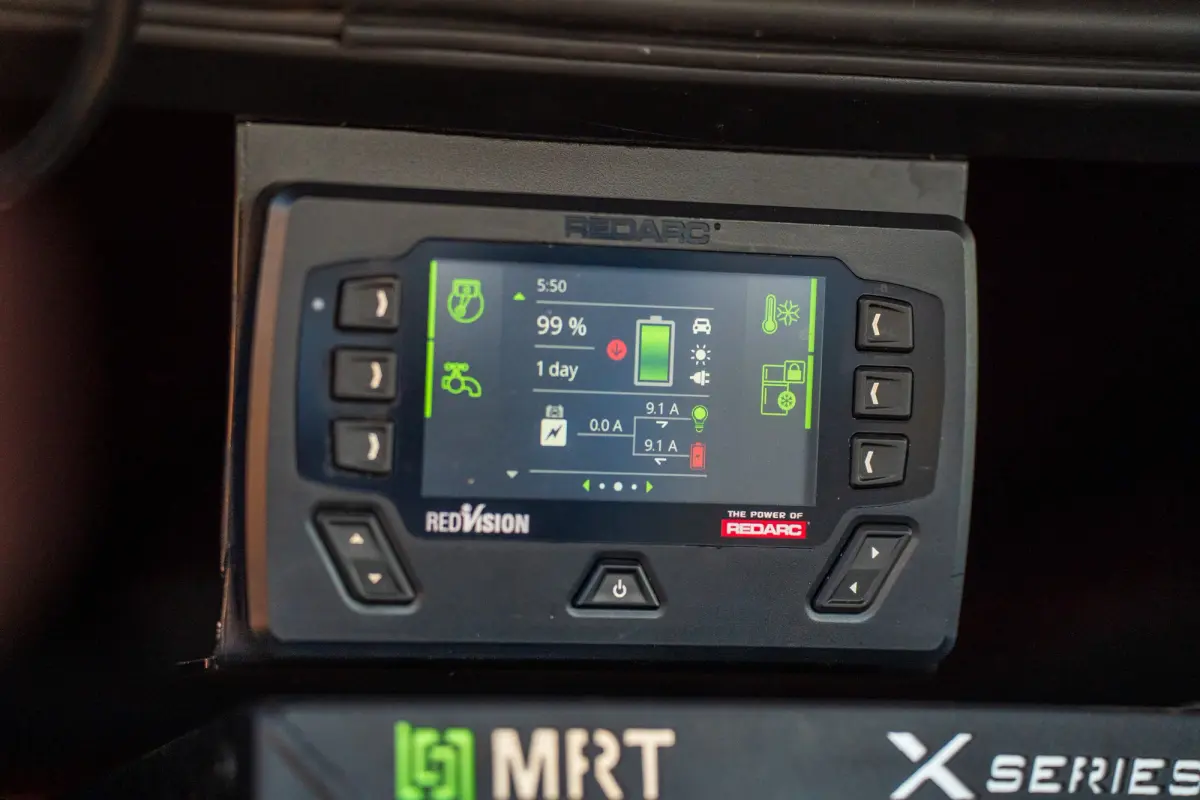
Battery gauge
Common Motorhome Battery Problems and How to Fix Them
Battery issues are common—but usually easy to diagnose.
Battery Not Holding Charge
Causes:
- End of lifespan
- Repeated deep discharge
- Sulphation (AGM)
- Parasitic drains
Fix:
Test with a battery monitor. If it’s old or degraded, replacement is often the best option.
Battery Going Flat Overnight
Causes:
- Hidden power draws (fridge, electronics)
- Faulty wiring or isolator
Fix:
Isolate circuits and track usage with a battery monitor.
Battery Charging Slowly
Causes:
- Incorrect charger profile
- Undersized solar
- Poor connections
Fix:
Check charger settings, clean terminals, and confirm solar output.
Battery Maintenance Tips for Australian Motorhome Owners
A few simple habits can dramatically extend battery life:
- Keep terminals clean and corrosion-free
- Use a battery monitor to track charge levels
- AGM: avoid dropping below 50%
- Lithium: store at 40–60% for long periods
- Secure batteries properly to prevent vibration damage
- Disconnect during long storage periods
- Store in a cool, dry location where possible
Australian heat is one of the biggest killers of battery performance—keep that in mind when mounting and storing your system.
Hit the Road with Confidence
The right motorhome battery comes down to how you travel. AGM remains a solid, budget-friendly option for occasional trips, while lithium is the clear winner for extended off-grid adventures.
Understanding your battery setup, including how it works, how to charge it, and how to maintain it, is one of the best investments you can make in your motorhome lifestyle.
Hitting the road?
Safeguard your lifestyle