

One of the first practical questions any prospective motorhome owner asks is: what licence do you need to drive a motorhome in Australia? The good news is that for most people, the answer is straightforward. Most motorhomes and campervans on the Australian market can be driven on a standard car licence. But the details matter, particularly when it comes to larger vehicles, weight limits, and what it means for your insurance if you get it wrong.
This guide covers everything from GVM thresholds and licence classes through to overseas visitor requirements and the legal and insurance risks of overloading. Whether you are buying your first motorhome or upgrading to something larger, this is what you need to know before you get behind the wheel.
Can You Drive a Motorhome on a Car Licence in Australia?
An RV on a beach
In Australia, you can drive most motorhomes and campervans on a standard car licence, known as a Class C licence. The key requirement is that the vehicle has a Gross Vehicle Mass (GVM) of 4,500 kg or less. This covers the vast majority of campervans, pop-tops, and mid-size motorhomes available on the Australian market, so for most buyers, no special licence is needed.
You must hold a full, unrestricted licence. Provisional and probationary licence holders are not permitted to drive motorhomes or campervans, regardless of GVM. This applies to both Australian residents and overseas visitors hiring or borrowing a vehicle. If you are unsure whether your motorhome falls under the 4,500 kg threshold, check the compliance plate inside the driver’s door as the GVM is listed there.
Understanding GVM: What It Means and Why It Matters
GVM stands for Gross Vehicle Mass. It is the maximum allowable weight of a fully loaded vehicle, including passengers, fuel, water, food, gear, and all fitted accessories. This figure is set by the manufacturer and listed on the compliance plate, typically located inside the driver’s door frame of every motorhome and campervan.
To understand how much you can safely carry, you need to know two numbers: the tare weight (the empty weight of the vehicle as it left the factory) and the GVM. The difference between them is your payload, which is the maximum additional weight the vehicle can carry. Many motorhome owners are surprised by how quickly payload is consumed. Four passengers, a full water tank, food supplies, bedding, outdoor gear, and a toolbox can easily add 500 kg or more.
To check your actual weight, find a public weighbridge, commonly found at truck stops, waste transfer stations, and some service stations across Australia. Compare the reading to your GVM figure. If you are over, you are legally overloaded, regardless of how the vehicle feels to drive.
When Do You Need a Higher Licence Class?
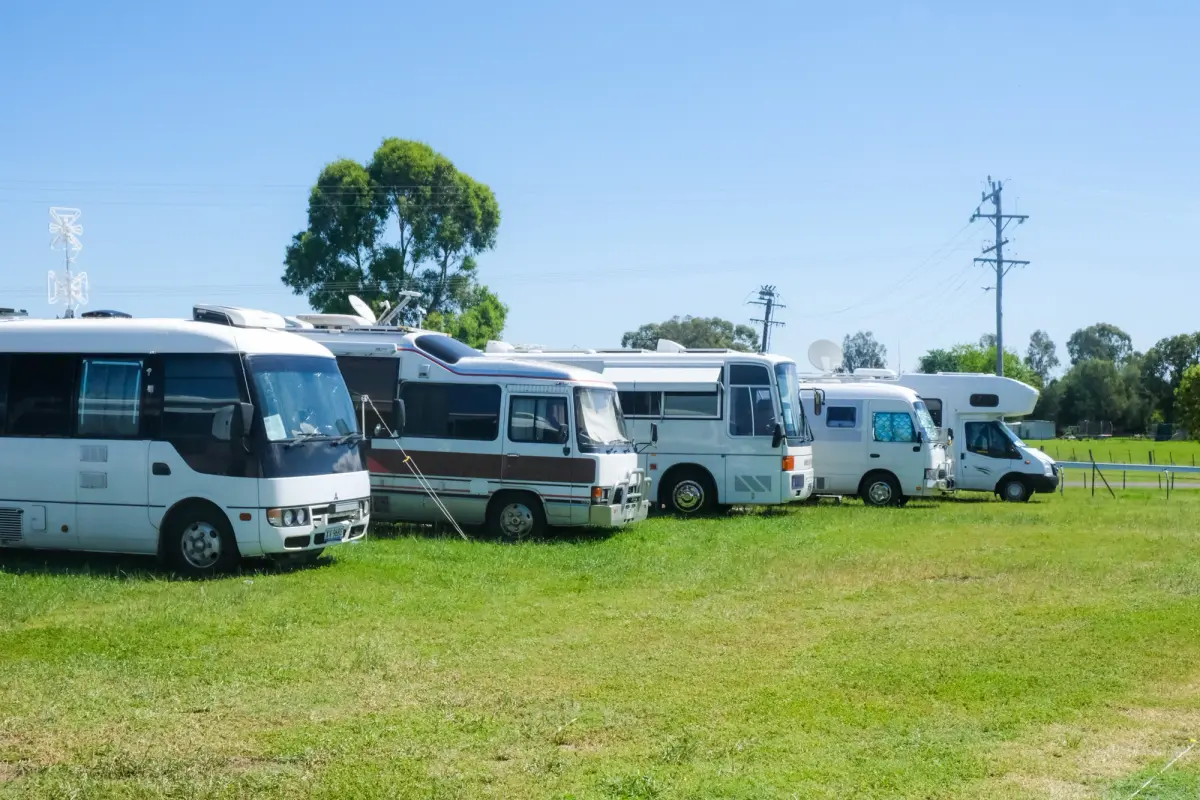
A lineup of RVs at a show
If your motorhome has a GVM above 4,500 kg, you will need a Light Rigid (LR) licence. This category covers vehicles with a GVM between 4,500 kg and 8,000 kg and typically includes larger motorhomes such as bus conversions, truck-based builds, and some premium six-berth models. To obtain an LR licence, you must have held a full Class C licence for at least 12 months, pass a written heavy vehicle knowledge test, and complete a practical driving assessment with a certified instructor.
For two-axle vehicles with a GVM above 8,000 kg, a Medium Rigid (MR) licence is required. This is rarely needed for standard motorhomes but may apply to some custom-built or imported large coaches. The MR licence process is similar to the LR but includes additional practical requirements due to the larger vehicle size.
While the GVM thresholds and licence class requirements are consistent across Australia, the process for obtaining an LR or MR licence can vary slightly between states and territories. For specific requirements, check with your relevant state transport authority:
- Transport for NSW
- VicRoads (Victoria)
- Transport and Main Roads (Queensland)
- Department for Infrastructure and Transport (SA)
- Department of Transport (WA)
- Department of Infrastructure, Planning and Logistics (NT)
- Department of State Growth (Tasmania)
- Access Canberra (ACT)
Maximum Motorhome Dimensions in Australia
In addition to weight limits, there are legal size limits for motorhomes on Australian roads. The maximum allowable dimensions are 12.5 metres in length, 2.5 metres in width, and 4.3 metres in height. Most factory-built motorhomes sit comfortably within these limits. However, if you are considering an imported, custom-built, or converted vehicle — particularly a bus conversion — it is worth verifying the dimensions against these requirements before purchase or registration.
Licence Requirements for Overseas Visitors
Overseas visitors can drive a motorhome or campervan in Australia on their foreign licence, subject to the same GVM limits that apply to Australian drivers. Your licence must be valid for the entire duration of your stay, and you must carry it with you at all times while driving. If your licence is not written in English, you will also need either an International Driving Permit (IDP) or an official English translation completed by a NAATI-accredited translator.
Most states and territories allow visitors to drive on their overseas licence indefinitely, as long as it remains current and valid. However, there are important exceptions. New South Wales and Victoria limit driving on an overseas licence to six months from the date of arrival, while the Northern Territory limits it to three months. After these periods, you will need to obtain an Australian licence to continue driving legally.
An International Driving Permit is not a standalone licence, but a translation document that must be carried alongside your original licence. IDPs are issued by the motoring association or authority in the country where your licence was originally issued and cannot be obtained in Australia. If you plan to drive a motorhome during your visit, arrange your IDP before you travel.
The Risks of Overloading Your Motorhome
man packing an RV
An overloaded motorhome is significantly harder to control. The practical safety consequences include reduced braking performance, compromised steering response, increased stopping distances, greater risk of tyre blowouts, and a higher likelihood of rollover on tight corners or steep descents. These risks are amplified on unsealed roads and in the remote areas that many Australian motorhome owners travel through.
Australian police and transport authorities have the power to conduct roadside weight checks, and they do, particularly on highways in regional and outback areas. Exceeding your legal GVM can result in significant on-the-spot fines, and in serious cases, your vehicle may be defected and taken off the road until the overloading is resolved.
Here is where many motorhome owners are caught off guard: driving an overloaded vehicle can also void your insurance cover. If you make a claim following an accident and your motorhome is found to have been operating over its legal GVM at the time of the incident, your insurer may decline the claim entirely. This applies to both damage to your own vehicle and third-party liability claims. It is one of the most commonly overlooked risks in motorhome ownership, and it is entirely avoidable by knowing your numbers and checking them regularly at a weighbridge.
Getting Road-Ready in Your Motorhome
For most Australians, driving a motorhome requires nothing more than a standard Class C car licence. The 4,500 kg GVM threshold is the key number to remember. Stay at or below it and you are covered. If your motorhome exceeds that weight, a Light Rigid licence is straightforward to obtain through your state transport authority.
Before you hit the road, take the time to check your GVM, confirm your licence eligibility, and weigh your fully loaded setup. A bit of preparation helps ensure your motorhome adventures are safe, legal, and stress-free.
New setup needs insurance?
Safeguard your lifestyle